This incomplete list of trip favorites use to live in the side bar. She graciously moved to a post knowing that no matter how painful, it's time for the Owlhouse to move forward.
Cape Disappointment- Long Beach Peninsula, WA
Saturday Market- Eugene, OR
Crater Lake, Oregon
Barack Obama, 2008
Cowboy Poets- Elko, NV
Gilgal Sculpture Garden- SLC, Utah
Lazy Lizard- Moab, Utah
Mesa Verde, Colorado
Carver Brewing- Durango, CO
Taos Pueblo, NM
Georgia O'Keeffe Museum- Santa Fe, NM
White Sands, NM
Chiricahua Mts, AZ
Bisbee- Bisbee, AZ
Desert Museum - Tucson, AZ
Sonora Co-housing - Tucson, AZ
Sam's Family Spa -Desert Hot Springs, CA
Ghetty Museum - Los Angles, CA
Camp Ocean Pines - Cambria, CA
Pipestone Vineyards - Paso Robles, CA
Sacramento Valley School - Sacramento, CA
Guemes Island - Washington
Lake Okanagan - Kelowna, British Columbia
Lake Louise - Banff, British Columbia
Kaslo- Kaslo, British Columbia
Kamloops Farmer's Market - Kamloops, British Columbia
Touchstone Farm - Mayerthorpe, Alberta
Gaetz Lake Sanctuary- Red Deer, Alberta
Local Currancy - Calgary, Alberta
Tyrrell Dinosaur Museum - Drumheller (Badlands), Alberta
Glacier National Park - Montana
Coeur d'Alene Library - Idaho
Grand Coulee Dam -Coulee, WA
Showing posts with label farms. Show all posts
Showing posts with label farms. Show all posts
Tuesday, October 02, 2007


Thursday, September 06, 2007
Real World
 At what point is it acceptable to swear in public? To/at your children's doctor?
A couple of guys joined us at the back of the bus last week. Not entirely sober at 10am but friendly. "Look at the little man," the one on the aisle gestured to Ukiah. And they looked at Ukiah, apparently charmed by his "training to be a little man" posture. "Hey, you gonna be a lawyer?" Ukiah shook is head, politely. "No, really. What you gonna be? Cause if you a lawyer you ain't never gonna lose a case. I feel sorry for that district attorney, cause if you just smile, it's all over. You got a good smile, little man. How many cavities you got?"
Aslin pretended to sleep as Ukiah graciously nodded, smiled, met a high-five and turned to me for reassurance. "No cavities."
"See that?" the aisle man asked his window friend. "See, you got somebody who loves you. You know that? I want you to know..." Window man was unsuccessful in getting his friend to shut up or leave the nice kid alone. Aisle man continued, "Your mamma take a baseball bat to the back of the head for you." He smiled at me, approval of my parenting. "I'm not trying to be graphic, but she'd move right in at get hit for you... I'm just trying to tell you how much love you got...You guys all right..."
The unlikely family-support workers left the bus a few blocks before us.
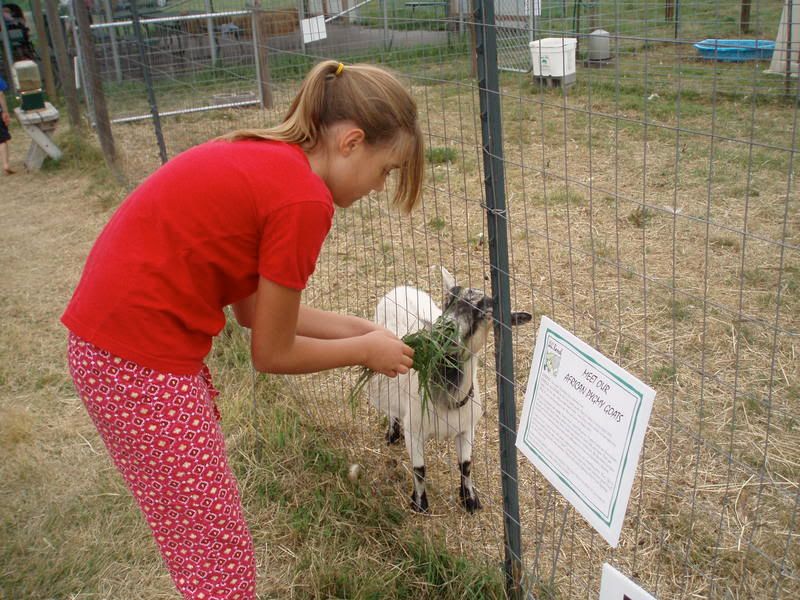
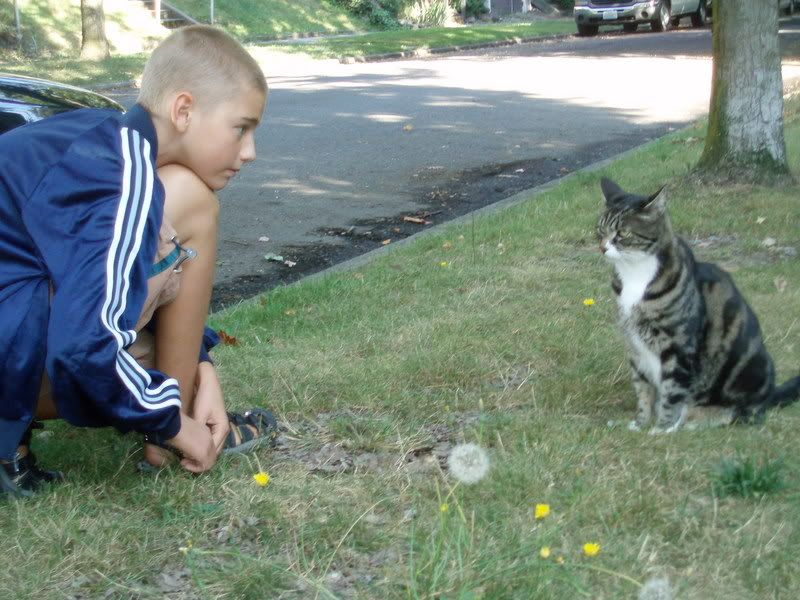
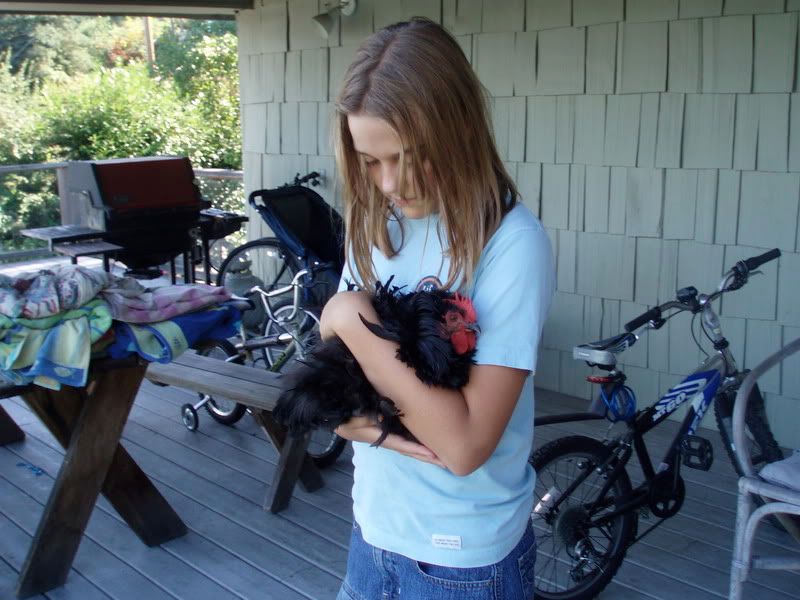
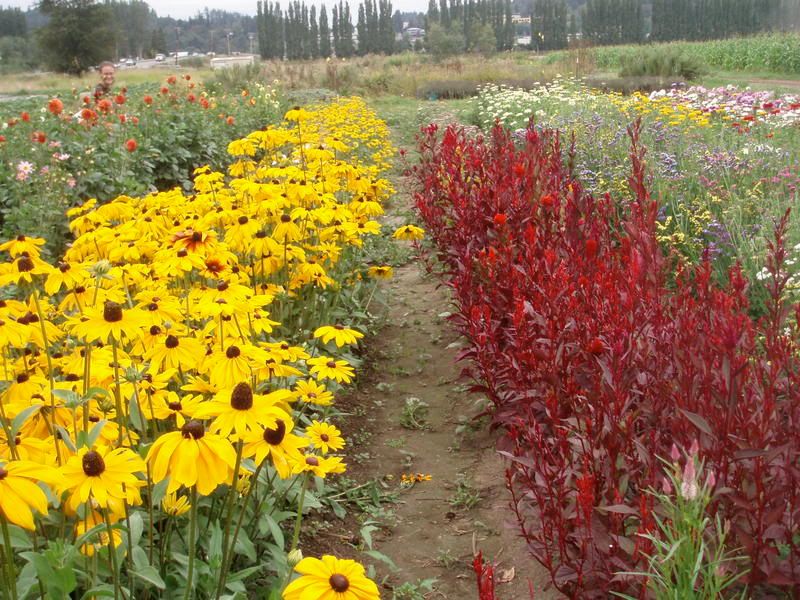
 More highlights from our recent weeks in the real world-
- A cross city walk from Belltown to Seattle Center, to Pike Place, to the International District, to a different bus to Ranier, where we walked to collect the truck from the shop.
- Meeting Rasta the rooster
- Cat sitting Suri
- Evaluating diversity in gaming and the Army's presence at PAX
- Pickin berries, apples, flowers and feeding goats
- Suffering through the "worst game of capture the flag ever"
- Turning down a dream job
- Helping Grandma move furniture, boxes and files
- Reserving a dozen manga titles at the library
- Cooking pizza, stuffed peppers and plum sauce
- A bike ride to the dog park
- Mowing the neighbor's yard
- Hosting a veteran of the 1st Gulf War, learning of his recently discovered uranium bone-poisoning
- Inventorying the My Little Pony and Magic card collections
- And a bad encounter with the doctor
 This whole resumption of normal has proven challenging, especially as we opted not to return to our routines. Brad's making bloody ducks and severed limbs. My new job comes with Sounders tickets but with out a classroom. We're experiencing a prolonged/delayed broken heart in Clearwater's move out of town. I miss preschool and we all miss the staff discount on groceries. In two weeks Dawn and Kalin will move next door. And we've already eaten more than half our winter supply of blueberries.
 Adding to the challenge and self-doubt of putting our lives back together, "well child" check-ups that included the question, "how long are you going to protect them from the real world?" Height, weight, blood pressure, spine check and "That's not a judgment, I respect home and alternative schooling, but why don't you just put them out there?"
I've been wondering what shape our lil' blog might take as we resume a settled life, not especially anxious to join the masses of family stories already floating around. In part because writing with our names attached, means censoring to protect the subjects and/or audience. And partly because with out the built-in drama of the trip of lifetime, what could there possibly be to say? Then I remembered that scenes from the real, day-to-day lives of ordinary people make some of my favorite stories.
 So, I confirmed with the doctor that I did feel judged, not at all supported. I listed a half dozen of the kids' real world engagements and kindly told him, "don't fucking push me on this." My eloquent response would have sounded a little something like "I can talk educational philosophy and developmental psychology for hours, probably weeks and surely the rest of my life. You've only got about 5 minutes, so listen to the kids' lungs, answer their questions and offer me some resources, if you'd like." I think he heard my message even in its abbreviated form.
For the record, Ukiah's 5'3, Aslin 5'1.75. Both appear healthy despite my unwillingness to allow them to participate in the real world. Maybe because I'd take a bat to the head for either of them. I'm not trying to be graphic.
Wednesday, August 22, 2007
Priorities
 The homecoming "to do" list is lengthy, growing daily. We have managed to pay the house insurance, sort toys and go for Vietnamese food. Visiting our parents was fantastic, Ukaih's adjusting to the library construction- requesting holds at another branch, and we spent the afternoon with a man who left Sudan at age 5, spent 16 years in a refugee camp in Kenya, and on his fourth day in the US, joined us for a walk to the lake. Buttercup is about 75% unpacked. We adults each have a job interview this week. The kids have a new cat-sitting gig. We love having our own washing machine.
Between visiting with friends and sorting clothes now too small for the kids, we've seen a play, been wowed by examples of New Zealand's early childhood education practices and harvested enough tomatoes for a decent taco salad. In other words, we're thriving in the midst of uncertainty. It could be that yoga, television, soccer and cocktail parties are helping us through...
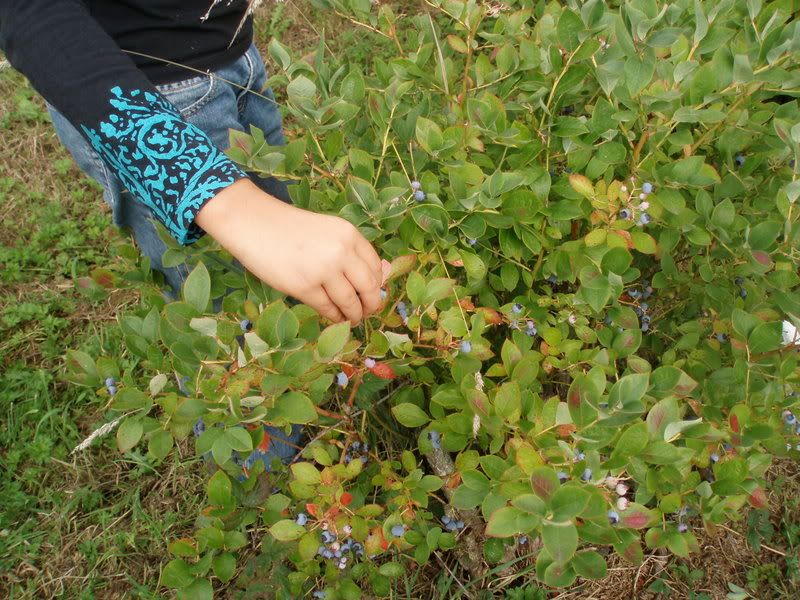 We weren't here to experience the unusual weather patterns this winter. No flooding or extended power outages for us in the southwest. Are atypical patterns the new norm, or have we forgotten- does it usually rain for multiple days in August? Does the temperature generally top out in the mid-70's? I'm a little worried that it's already sweater-season for me, but it means great blueberries into late August!
 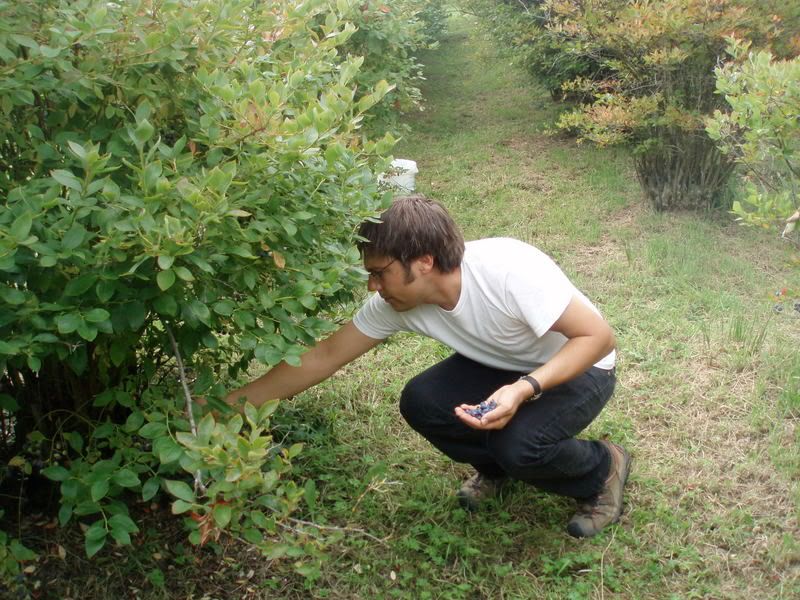 We spent about two hours at Mercer Slough Blueberry Farm, sampling high and low bush varieties, limiting our interactions with spiders. Assuming we can find a kitchen scale, we'd like to do a little math project. What's your best guess on the number of blueberries in 18.25 pounds? Cost per berry at $1.25/pound? Inquiring minds want to know. And not just because we're jobless and working with a tight budget.
 The plan is to make freezer jam in the morning, before haircuts or a trip to Value Village. We won't be following the recipe that calls for a can of blueberry pie filling and box of raspberry Jello. We're going the old fashioned route, pectin and lemon juice. Unless someone has a more inspired suggestion?
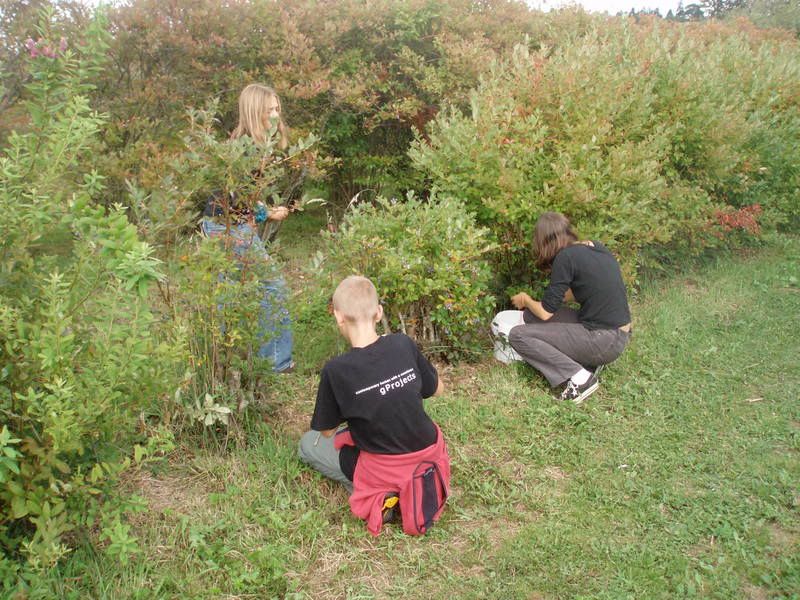 A favorite come pumpkin season, South 47 Farm has organic, u-pick, thornless blackberries. Between resume writing, filing tax returns and thanking our long list of travel hosts, we hope to pick at least 10 pounds next week.
Wednesday, July 25, 2007
the best part of waking up

is the sound of rain filtering through the deck floor and splashing to the patio outside my window. Real rain. Not the warm drops that evaporate as soon as the sun considers dismissing the clouds. Real rain. Enough to wash the scent of heat from the asphalt and form pools in the joints where tree branches meet their trunks. Two hours of real rain.
"Isn't it great?!" the rest of us nod in agreement with Ukaih, carry the camera to the neighbor's garden and feel a little home-sick.
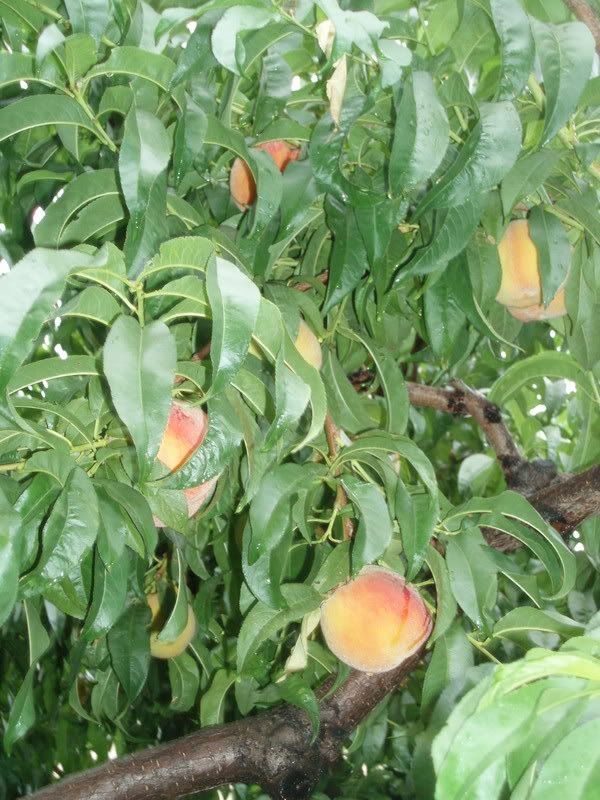
It's been a double apricot season for us- Tucson in May and here in Orem a couple weeks ago. If we're lucky, we'll have peaches before our Saturday departure. Unless of course the city's chemical defense against the Japanese beetles has poisoned the fruit. Add to the list...
- Advising against vegetable gardening until 2010 because pesticide use has contaminated soil and ground water while endangering beneficial insects - crazy
- Horticulture and gardening programs for inmates and their communities- not crazy
Sunday, July 01, 2007
$76 billion
is up for grabs in this year's Farm Bill.
As much as I'd like to write about the importance of impeaching our criminal vice president, this week I'm banging my head on the wall for a different cause.
This past year, we Owlhouse-ians picked green beans in the freezing rains, evil eyed carrot-eating deer, harvested thousands of pounds of potatoes, planted cucumber seeds to the second knuckle and sheltered berries from sun and storm. The farmers we worked with are land stewards, cultural historians, nutritionists, inventors, musicians, educators and healers. Not to mention they're responsible for some of the best food we've ever eaten. Chews Wise has a terrific post outlining the proposed investment in organic farming. You don't have to have goat-milking experience to recognize the importance of federal support for organic practices.
At Mulch Blog, The Environmental Working Group will keep you up to date. Organic Farming Research Foundation has everything else you need to know.

So sign the petition already.
That's 76 billion- with a "B"
So even if we grant Charles Schwab a half-million for his private duck-hunting club "rice farm" and pay Scottie Pippen and Ken Lay to manage their "conservation lands," there should be plenty left to invest in sustainable farming methods and operations.As much as I'd like to write about the importance of impeaching our criminal vice president, this week I'm banging my head on the wall for a different cause.
This past year, we Owlhouse-ians picked green beans in the freezing rains, evil eyed carrot-eating deer, harvested thousands of pounds of potatoes, planted cucumber seeds to the second knuckle and sheltered berries from sun and storm. The farmers we worked with are land stewards, cultural historians, nutritionists, inventors, musicians, educators and healers. Not to mention they're responsible for some of the best food we've ever eaten. Chews Wise has a terrific post outlining the proposed investment in organic farming. You don't have to have goat-milking experience to recognize the importance of federal support for organic practices.
At Mulch Blog, The Environmental Working Group will keep you up to date. Organic Farming Research Foundation has everything else you need to know.
So sign the petition already.
Saturday, June 16, 2007
H2O
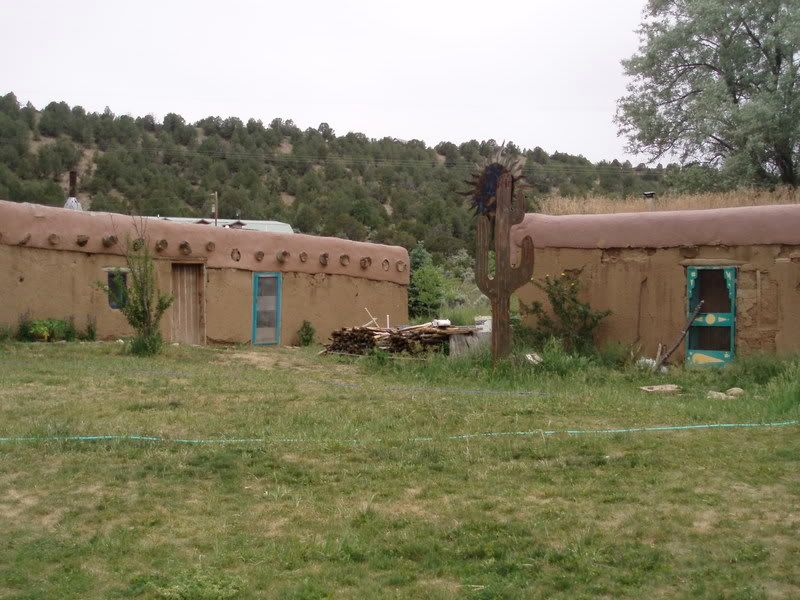
It seems like you'd feel the effects of drinking bad water pretty quickly, say within 24 hours. So we should be in the clear. It was Thursday afternoon, a few hours before the community pot-luck, when Jeremiah mentioned that flooding of the acequia brought water in to the well-house, contaminating the water. He'd never found animals or their droppings in the house and thought we should be fine. Just wanted to inform us.
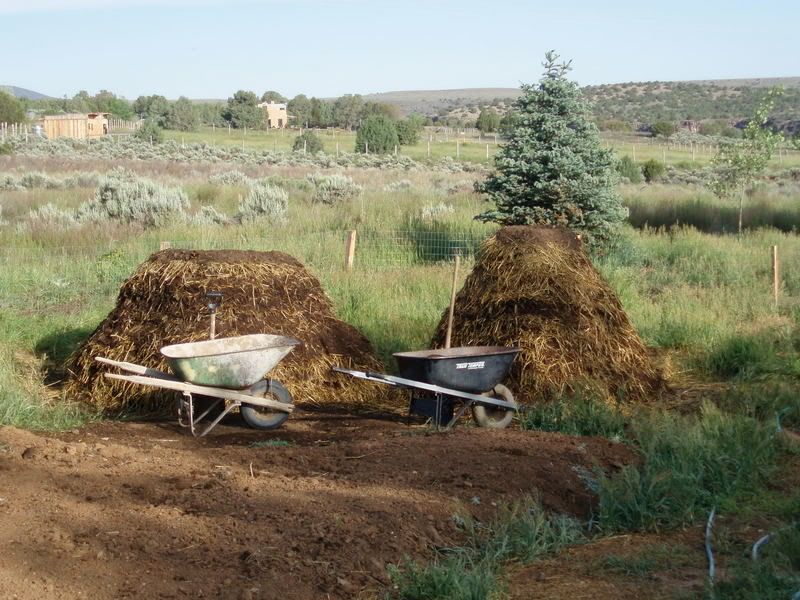 Much of our work here at New Buffalo has been dedicated to building the two wonders of the composting world. Thursday morning, in the shadow of the first pile, the walls of the second collapsed as we tried to square it. Wood chips. Their thirst requires endless time with the hose. Time which could be spent shoveling manure and bringing over the next wet bale of straw. I went to the acequia for buckets of water. There'd been some trouble and plenty of talk about the water. Water rights are a hot topic, a point of conflict that has sprouted books and major motion pictures. Here, the acequia didn't start running the day it should have. The ditch walls need repair. No, the ditch needs widening. The water flooded a corner of the greenhouse. A break in the wall creates a wetland for a young grove of drought tolerant trees. Yesterday's wall retrofit protects the adobe that sits five feet from the irrigation ditch, on lower ground. Maybe we should turn the water off. No, better to let it run over the land. If we don't use it, they'll take it away. The people in Seco will be really mad if we just let the water go back to the river, wasted. Five-gallons at a time, carefully, I pull water from the channel to the compost until it's time for planting.
 Following Machei's lead, we planted cucumber and squash in a double square pattern, gardening French-intensive style. Until we noticed water flowing into the sunflower bed. We grab shovels. Our work to contain the too rapid current is interrupted by down-stream David of the straw bale mansion. Do we know that we're creating too much dirt in the water, hurting his fish pond? The acequia gate isn't supposed to be open all the way. He gestures, laughs angrily. Our ditches aren't fully operational. For thirty minutes he talks as the three of us who know nothing of the water system continue shoveling. He, semi-long term resident now being negatively impacted by too much water, doesn't go up the hill and correct the flow himself. We later learn that a day earlier he told Aslin and the Buffalo girls they couldn't play on his trampoline. Because even if they did play with his kids, it wouldn't be in their hearts.

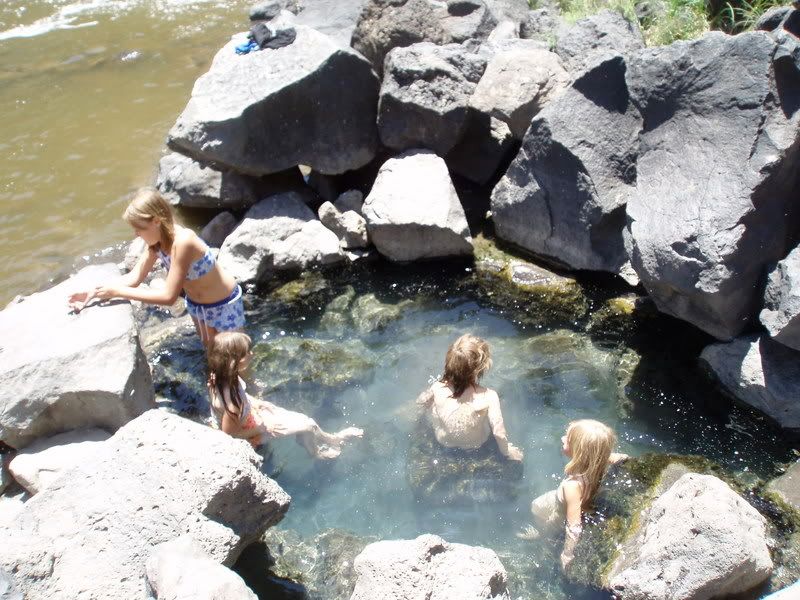
 Plenty of characters around. We hiked to some hot springs along the Rio Grande with a kinder, more interesting person. Between wild roses and river willow, carefully avoiding nettles, we walked along the Rio Hondo, eyes open for petroglyphs. A waterfall, not there when we walked a couple days ago and never before seen by the locals we accompanied, thundered down the cliff. Could it be the mismanaged water? Five of us worked our way across the branches littering the base of the falls. One of us, who against advice opted not to wear shoes, lost his right flip flop. Had we known it was another two-miles to the springs, we'd have turned back. The warm pool was swarmed by little green flies, the cool by mosquitoes. We relaxed none the less, resting before the steep path of lava rock up from the gorge followed by a long walk home.
  We'd given in to our need for rest and were headed for a shade tree when Manzie thumbed a ride from three fisherman. Seven of us piled in the back of their pick-up, counting our blessings. A fine story to narrate over dinner shared with the family who welcomed us here.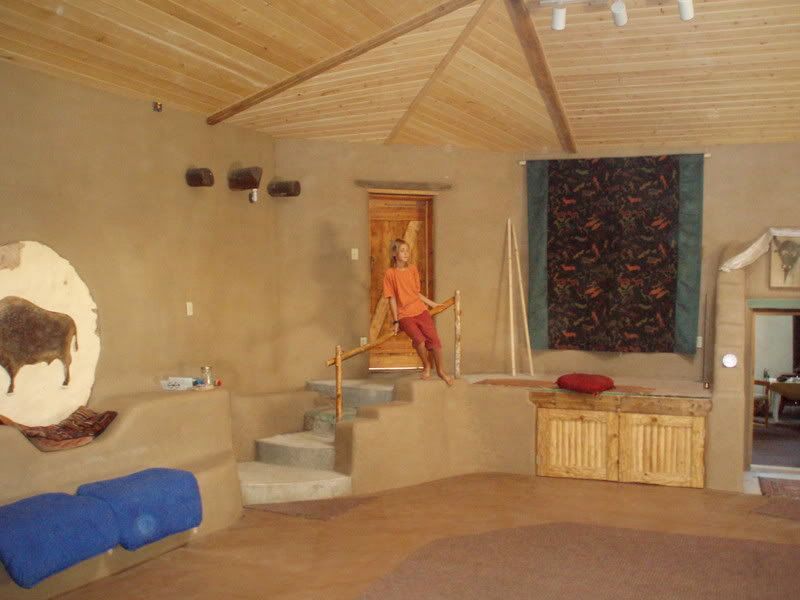
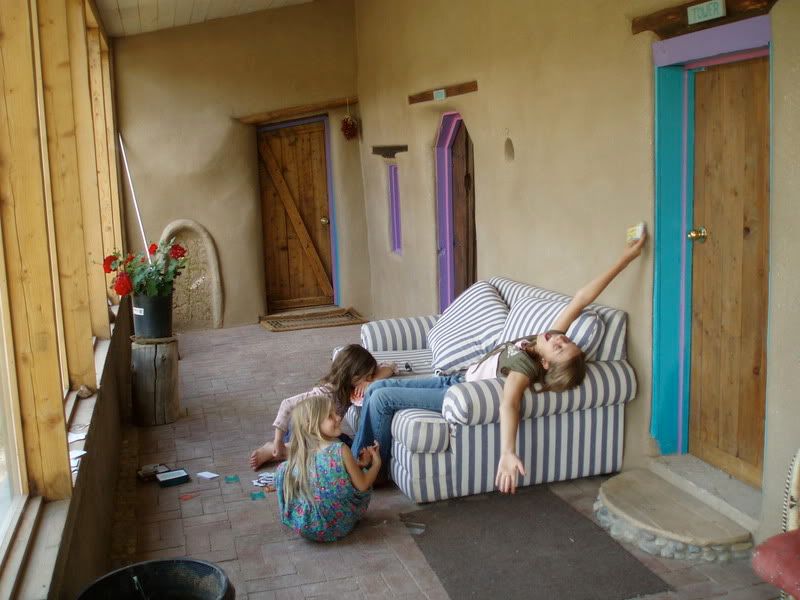 It's been great. Thanks to Nyna, Machei, Madrone, Manzie, Magnolia, and all at New Buffalo.
Wednesday, June 06, 2007
10,886 to go
Ruidoso Downs, 5/28-6/4


At the intersection of playing in the mud and sustainable building, just off Hwy 70, lies the base of a compressed-earth-block shop. In India, Habitat for Humanity uses a manual press to form the bricks. Here, Luther's used a mechanized version, built by a conservitive father-son team and powered by a bio-diesel tractor, to form over 3,000 block so far. Brad and Luther set the first line of bricks, 114. When all is said and done, the truces will be hoisted onto the 11,000 brick structure.

Surprisingly, Aslin didn’t opt for a swim in the Rio Ruidoso. Luther and Amanda have a great little spot along the river. If the neighbor kids don’t chop any more willow, I’m predicting a hammock sanctuary by fall.


Lesson of the week- Basil germinates with a satisfying quickness. The pollinator blend from Seeds of Change may take a little longer. Ideally, the borage, millet and butterfly weed will ease the hummingbird’s nectar habit. Extra bonus if the seeds step into a cover crop role, defending young apple trees from horehound and the ever pesky thistle. Safe from deer and dogs, the radishes are raising themselves from the ground. A dense patch of baby cabbage makes a strong case against planting in strong New Mexico winds. Walls of water shield a tomato crop sure to encourage more of Luther’s hand made ravioli. There’s a good chance we’ll meet this garden again, in a few years when the asparagus has settled in.
 It’s a little overcast. Nothing ominous like yesterday’s break from 80-degree weather that delivered hail to the fragile celery starts, but the blue sky is broken, shading sections of the hills on either side of us. So ends our week at Ruidoso Downs’ Blue Tube Farm and (recently fenced!) dog park. Or as we like to call it, our second Craig’s List Miracle.
Many thanks to Luther, Amanda and the animals for agreeing to host us months later than expected!
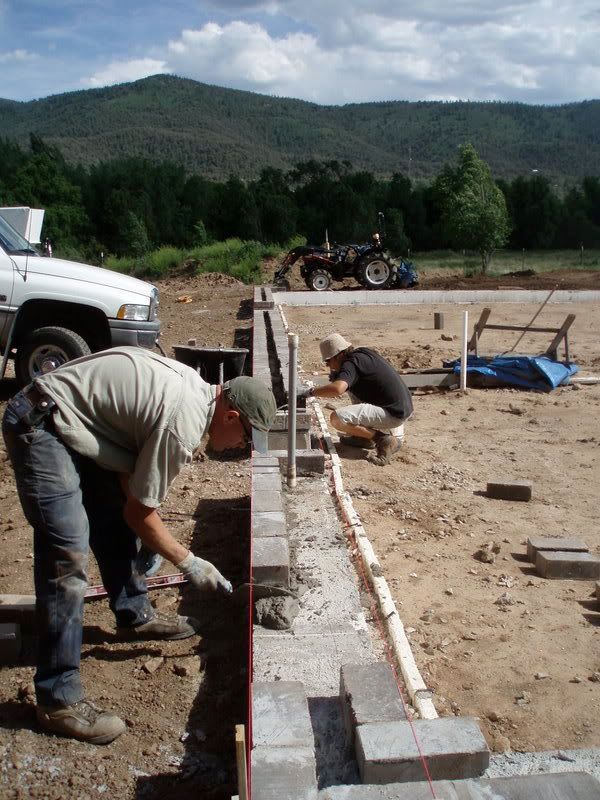
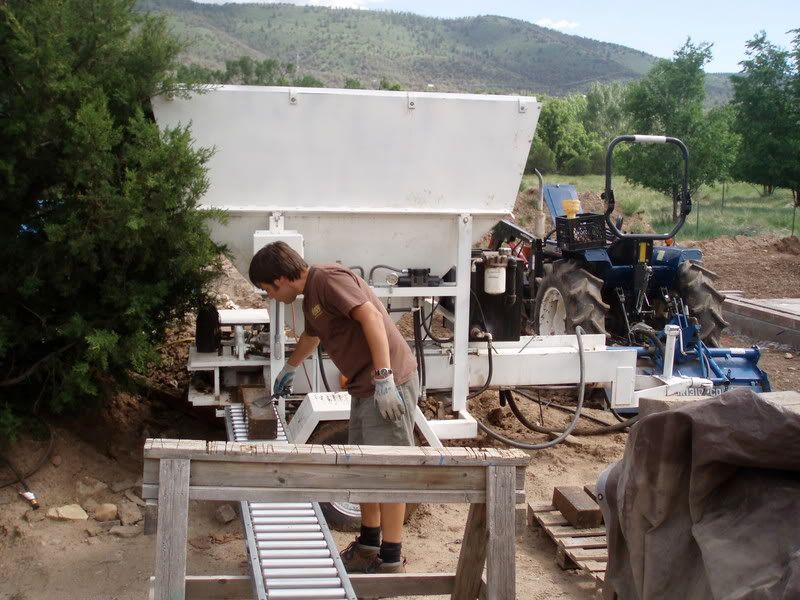
At the intersection of playing in the mud and sustainable building, just off Hwy 70, lies the base of a compressed-earth-block shop. In India, Habitat for Humanity uses a manual press to form the bricks. Here, Luther's used a mechanized version, built by a conservitive father-son team and powered by a bio-diesel tractor, to form over 3,000 block so far. Brad and Luther set the first line of bricks, 114. When all is said and done, the truces will be hoisted onto the 11,000 brick structure.
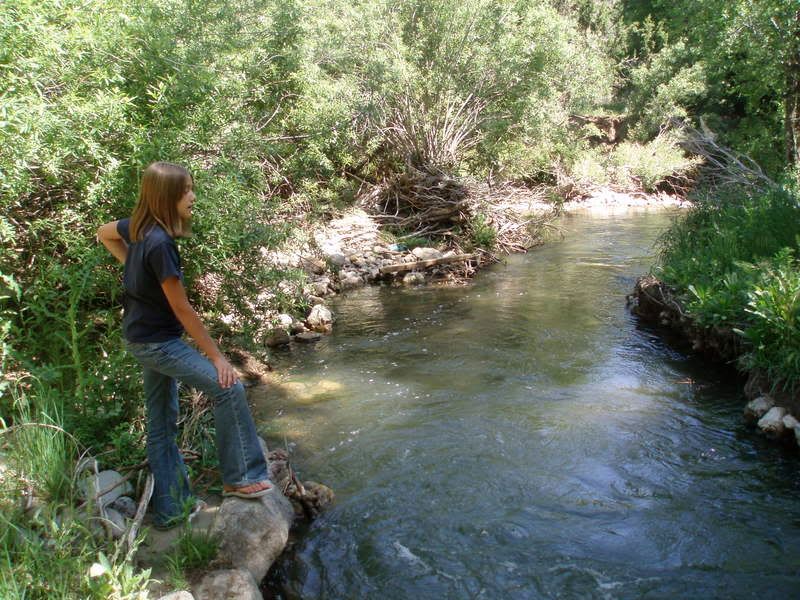
Surprisingly, Aslin didn’t opt for a swim in the Rio Ruidoso. Luther and Amanda have a great little spot along the river. If the neighbor kids don’t chop any more willow, I’m predicting a hammock sanctuary by fall.
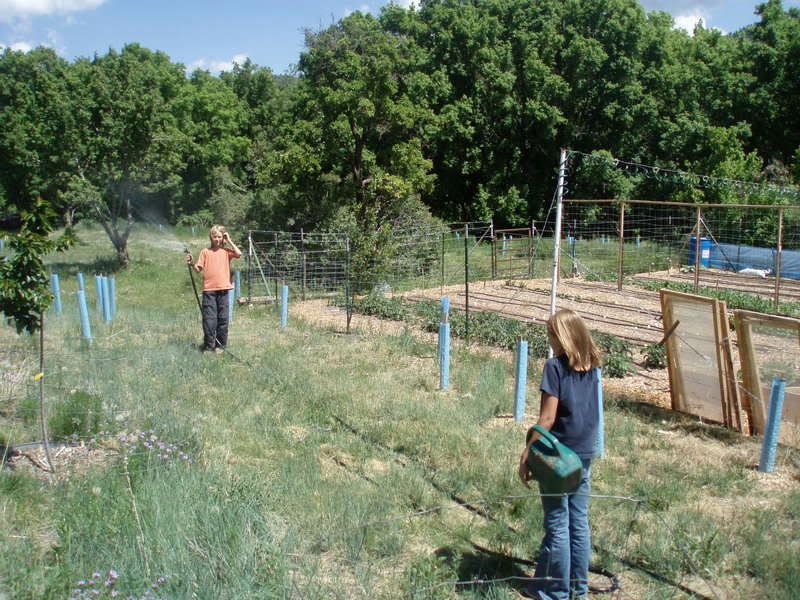
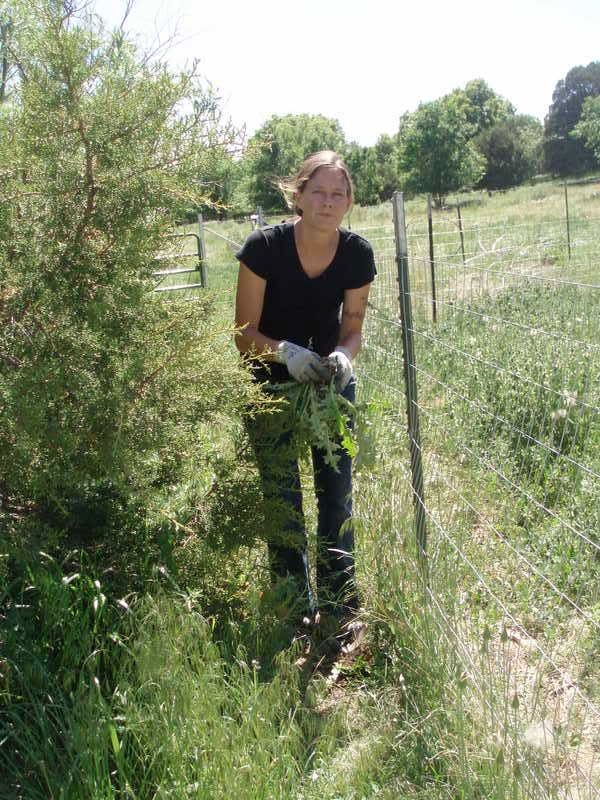
Lesson of the week- Basil germinates with a satisfying quickness. The pollinator blend from Seeds of Change may take a little longer. Ideally, the borage, millet and butterfly weed will ease the hummingbird’s nectar habit. Extra bonus if the seeds step into a cover crop role, defending young apple trees from horehound and the ever pesky thistle. Safe from deer and dogs, the radishes are raising themselves from the ground. A dense patch of baby cabbage makes a strong case against planting in strong New Mexico winds. Walls of water shield a tomato crop sure to encourage more of Luther’s hand made ravioli. There’s a good chance we’ll meet this garden again, in a few years when the asparagus has settled in.
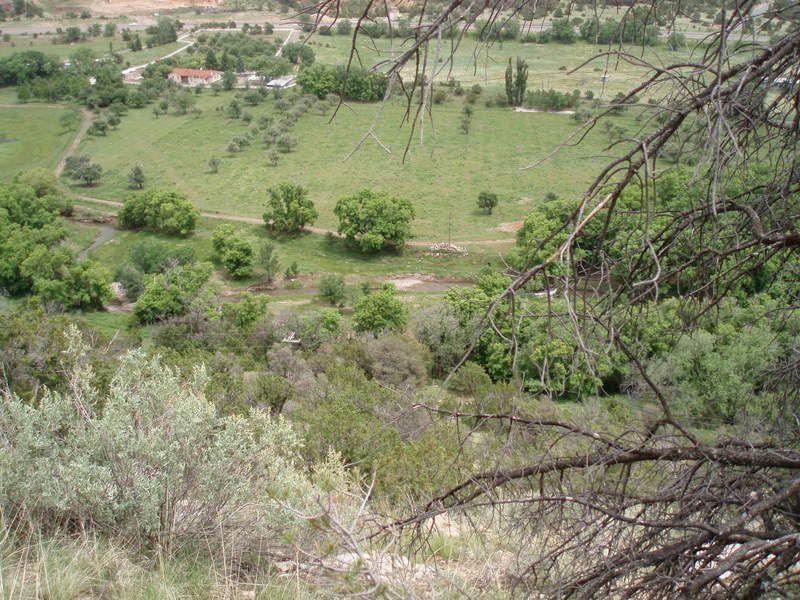 It’s a little overcast. Nothing ominous like yesterday’s break from 80-degree weather that delivered hail to the fragile celery starts, but the blue sky is broken, shading sections of the hills on either side of us. So ends our week at Ruidoso Downs’ Blue Tube Farm and (recently fenced!) dog park. Or as we like to call it, our second Craig’s List Miracle.
 Many thanks to Luther, Amanda and the animals for agreeing to host us months later than expected!
Thursday, May 17, 2007
mid-thought news-roundup
Hugo Chavez has been accused of "using [Venezuela's] state oil company to funnel billions of dollars to his social projects."
"His." I could be generous and suppose that Wall Street Journal reporter, Jose de Cordoba meant Venezuelan social projects, rather than a health care system or farm established solely for use by the President. But this appears not to have been a verbal stumble for de Cordoba. In today's article, Farms are Latest Target in Venezuelan Upheaval, he goes on to state that land reform is possible because by 2005, Mr. Chavez "controlled the courts as well as congress..." The socialist reforms undertaken by the Chavez government make use of "rhetoric" that "smacks of the 1960's..." "Some Chavez initiatives recall disastrous past experiments with collective agriculture, such as... the Cuban revolution, which helped turn one of Latin America's richest lands into one of its poorest."

Millions of acres, 8.8, have been reclaimed for agricultural use by the poor. Less than half the distributed land was owned by the state. Micro-lending programs have been corrupted. Food production appears to be down. Too bad de Cordoba "reports" with such bias and ignorance of history politics and economics that his writings on the challenges of the nation's current revolutionary undertakings can not be taken with any confidence.
 While the front page gives gallery space to the dangerous faults of returning land and trusting food production to the masses under a socialist system, today's WSJ page D-1 gives us a rosy version of the same story, under our very own capitalist system. For Sale: Condo w/ Chicken Coop, by Sara Schaefer Munoz shines light on a growing trend among housing developers. "Forget the golf course community," she tells us. The demand wasn't necessarily quick access to the gentleman's game. It was about living in a green community, where outdoor space and views are protected. Condos and new homes are being built around existing farms, or in conjunction with new agricultural developments.
So, a developer in southwest Florida constructs a 17,000 acre housing community surrounded by "73,000 acres including a nature preservation and a cattle farm" and the WSJ states that "for city folks, moving to a farm can require some adjustment." When the democratically elected leader of Venezuela offers a free 2-year farm voc-tech program for urban poor, the WSJ considers it a "hodgepodge of Marxism, 'ancestral' Venezuelan farming methods and Cuban fertilizing techniques."
Are we clear now? Spend between $200,000 and million on a home with access (hands on or off) to an organic farm in Florida, and you're part of a pioneering, eco-friendly revolution. Start a farming cooperative under the leadership of a Latin American president working to end decades of corporate pillage and massive absentee landownership, and you're destined for (continued) poverty if not starvation.
(The Wall St. Journal arrives at the house every morning courtesy of a plethora of airline miles not eligible for use on actual flights.)
We're planning to head out on Monday, so I'm working overtime to meet my news junkie need. Other stories making their way through my mind-
» The F-16 flare drop over south Jersey. Not only is the story of note, but the comments at this site have been fantastic.
» James Comey's testimony before the Senate Judiciary Committee is notable as much for its content as for his candor and humility. Never, in a million years, would I have trusted John Ashcroft as the last line of defense for our constitution. Suppose history shows him as our last principled attorney general.
» US investors are finally just saying no to profiteering in war-torn Sudan. I'm overly optimistic in wishing that some of that pulled capitol would be directed, even "funneled" into social programs in the region.
» Christopher Hitchens is unapologetic in his lack of remorse for the recently deceased Jerry Falwell. This on the heels of Richard Dawkins' "...you're an atheist about all those Gods, some of us just take it one God further..." debate with Steven Colbert.
"His." I could be generous and suppose that Wall Street Journal reporter, Jose de Cordoba meant Venezuelan social projects, rather than a health care system or farm established solely for use by the President. But this appears not to have been a verbal stumble for de Cordoba. In today's article, Farms are Latest Target in Venezuelan Upheaval, he goes on to state that land reform is possible because by 2005, Mr. Chavez "controlled the courts as well as congress..." The socialist reforms undertaken by the Chavez government make use of "rhetoric" that "smacks of the 1960's..." "Some Chavez initiatives recall disastrous past experiments with collective agriculture, such as... the Cuban revolution, which helped turn one of Latin America's richest lands into one of its poorest."

Venezuelan Coffee Farm
Millions of acres, 8.8, have been reclaimed for agricultural use by the poor. Less than half the distributed land was owned by the state. Micro-lending programs have been corrupted. Food production appears to be down. Too bad de Cordoba "reports" with such bias and ignorance of history politics and economics that his writings on the challenges of the nation's current revolutionary undertakings can not be taken with any confidence.
 While the front page gives gallery space to the dangerous faults of returning land and trusting food production to the masses under a socialist system, today's WSJ page D-1 gives us a rosy version of the same story, under our very own capitalist system. For Sale: Condo w/ Chicken Coop, by Sara Schaefer Munoz shines light on a growing trend among housing developers. "Forget the golf course community," she tells us. The demand wasn't necessarily quick access to the gentleman's game. It was about living in a green community, where outdoor space and views are protected. Condos and new homes are being built around existing farms, or in conjunction with new agricultural developments.
So, a developer in southwest Florida constructs a 17,000 acre housing community surrounded by "73,000 acres including a nature preservation and a cattle farm" and the WSJ states that "for city folks, moving to a farm can require some adjustment." When the democratically elected leader of Venezuela offers a free 2-year farm voc-tech program for urban poor, the WSJ considers it a "hodgepodge of Marxism, 'ancestral' Venezuelan farming methods and Cuban fertilizing techniques."
Are we clear now? Spend between $200,000 and million on a home with access (hands on or off) to an organic farm in Florida, and you're part of a pioneering, eco-friendly revolution. Start a farming cooperative under the leadership of a Latin American president working to end decades of corporate pillage and massive absentee landownership, and you're destined for (continued) poverty if not starvation.
(The Wall St. Journal arrives at the house every morning courtesy of a plethora of airline miles not eligible for use on actual flights.)
We're planning to head out on Monday, so I'm working overtime to meet my news junkie need. Other stories making their way through my mind-
» The F-16 flare drop over south Jersey. Not only is the story of note, but the comments at this site have been fantastic.
» James Comey's testimony before the Senate Judiciary Committee is notable as much for its content as for his candor and humility. Never, in a million years, would I have trusted John Ashcroft as the last line of defense for our constitution. Suppose history shows him as our last principled attorney general.
» US investors are finally just saying no to profiteering in war-torn Sudan. I'm overly optimistic in wishing that some of that pulled capitol would be directed, even "funneled" into social programs in the region.
» Christopher Hitchens is unapologetic in his lack of remorse for the recently deceased Jerry Falwell. This on the heels of Richard Dawkins' "...you're an atheist about all those Gods, some of us just take it one God further..." debate with Steven Colbert.
Saturday, March 31, 2007
Happy Cesar Chavez Day
 At dinner tonight, raise a glass and toast a national hero and the farm workers he represents. Today marks the 80th anniversary of Cesar Chavez's birth. More than four decades ago, Chavez and his partners/followers formed the United Farm Workers in an effort to advance the rights of disenfranchised field workers. Using boycotts as legitimate means of advocating worker's rights, Chavez brought pressure to commercial farms notorious for exploiting workers. Efforts are underway to promote recognition of the Chavez legacy and further his vision through naming a national day of remembrance.
The Huffington Post has briefs on a lengthy string of web-articles.
Sunday, March 25, 2007
Tumacacori
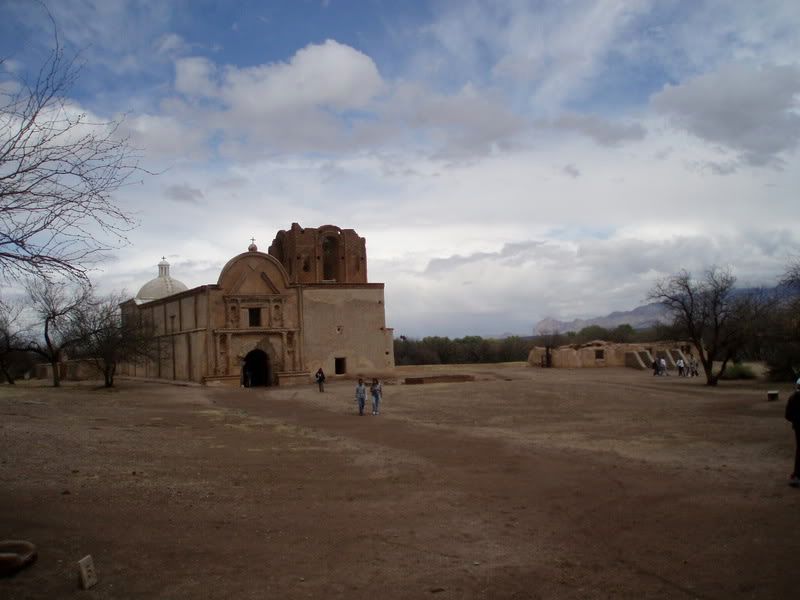
Earlier, I don't remember the exact date, we visited the San Xavier Mission. We just recently visited the Tumacacori (too-maw-caw-co-ree) Mission. They were very different but I thought Tumacacori was more interesting.
San Xavier was maintained and is still used as a church. The art and religious icons there were a bit overwhelming; everywhere you look, every inch is covered in carvings and paintings. There was no tour and not as much information as I would have liked, just one room stuffed with art.
 At Tumacacori, you could explore the entire grounds of the Mission. It was not maintained very much, so is now just kind of a ruin. We took a guided tour through a lot of the church and the grounds. Shortly after Tumacacori was complete, there was the Mexican Revolution and anyone from Spain had to leave Mexico, including the priest. The Mission never got another priest. The mission was used for another 20 years afterwards (except, of course, the church), but lack of support from the government, Apache raids and the hard winter of 1848 drove the last residents away and thus the mission was abandon.
-Ukiah
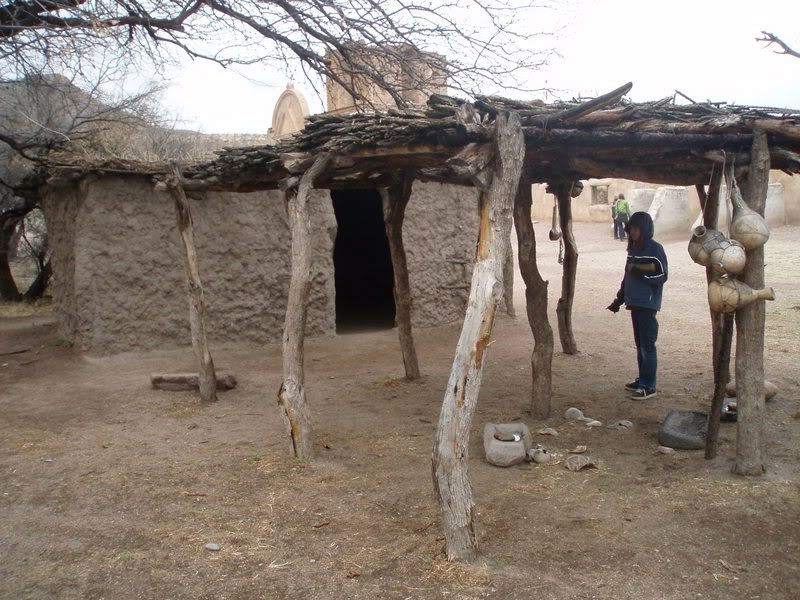 I really like Tumacacori. The Mission is old and beautiful. It's full of stories and memories- so full of life. There's so much you can't see even though it is right in front of you. There are rangers there because it is a park now. Ukiah and I got to be Junior Rangers (for a 2nd time- because we did that in Oregon too).
The people who lived here, the O'odham, lived in mud houses. They had tools and games that are so different from ours, but also the same. They cooked outside mostly and the got water from the Santa Cruz river. The women used willow and devil's claw plants to make baskets.
If you ever come to Arizona, you should visit the Mission
-Aslin
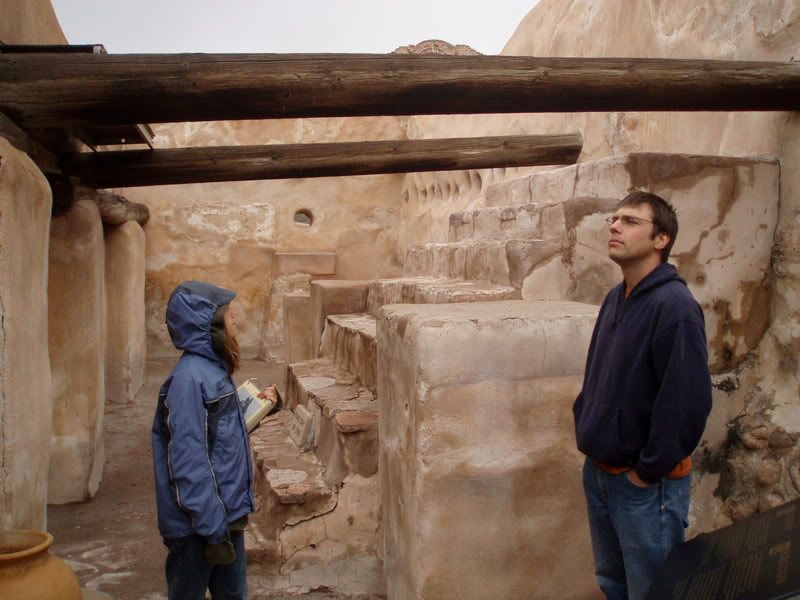
Graffati at Tumacacori dates back to 1849 and it's now protected by the federal government. Like San Xavier, this Mission marked the expansion of New Spain and the influence of Father Kino who first visited the area in 1691. Following a Pima (O'odham) uprising in 1751, the mission was relocated in 1753, to the west side of the Santa Cruz river, closer to the protection of soldiers at the presidio in Tubac.
A footprint of the modest 1757 original church lies just beyond the modern remains of Tumacacori. It served for 65 years, first under Jesuit missionaries, then Franciscans. Construction of the new church began in 1800. Lack of funds, disease, raids, and a host of other setbacks, including complicated design (the adobe bricks of the bell tower weigh 63 pounds each, with walls 9-feet thick at the base)- slowed the construction process. The church was dedicated in 1821, tower still incomplete, and served just 7 short years before the Spanish-born priests were expelled.
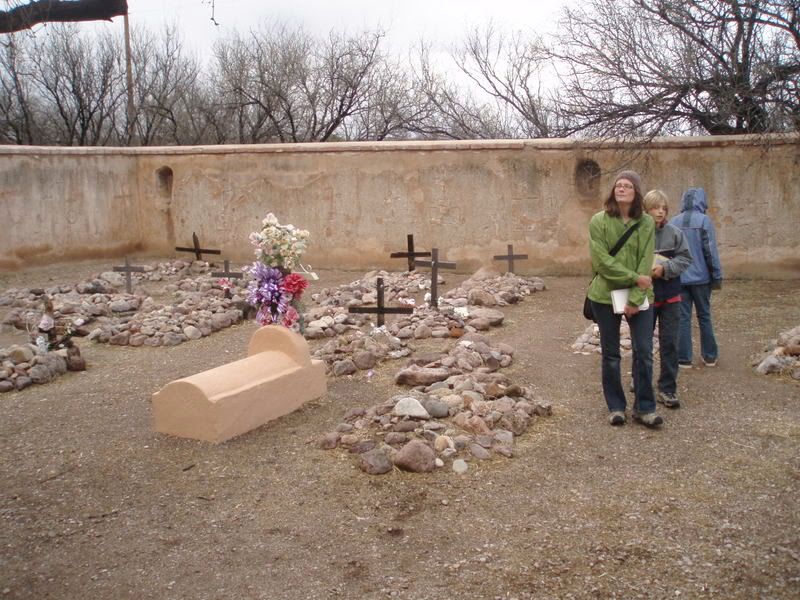 Mexican priests and a small group of O'odham Catholics continued to live and work at the Mission, raising livestock, growing native crops along with Spanish figs, pomegranates and peachs- for 20 years. In 1848, many icons and artifacts were transferred from Tumacacori to San Xavier and the Mission was abandon, bell tower scaffolding still in place.
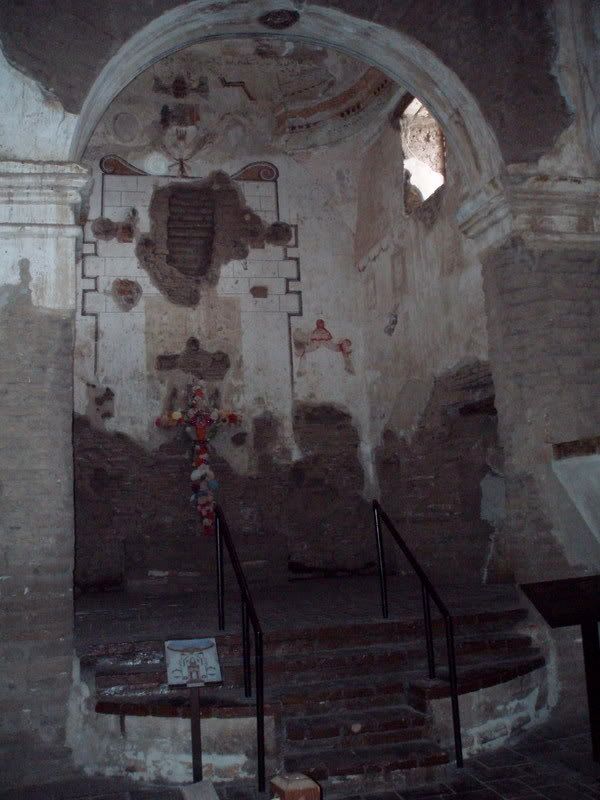 Until 1908 when the Mission became a National Monument, soldiers, cowboys, treasurer hunters and natives cycled through Tumacacori, building cook-fires in the sanctuary and carving their names above the holy water fountain. The chior loft is gone, the baptismal room crumbling. Hints of color offer some evidence of the 12 frames where the apostles once hung. The parks department and the O'odham natives now work jointly, not to restore the Mission, but to "keep it standing" after 250 years of weather, use and graffiti. -Nora
Sunday, January 07, 2007
Wine and Company
A hundred thousand acres of ranchland gave way to hillsides lined with vines. Copper-colored ribbons flicker warnings to next spring’s birds. Another winery with “stunning patio views” announced at every highway exit. Trendy tasting room/galleries dot the newly revitalized down town core. The wine country was unmistakable. We, were lost.
We circled the cemetery three times before stopping at a Honda dealership to ask directions. Certain roads were missing from the map and intersections could not be expected as they appeared in the 2005-06 Paso Robles visitor’s guide. For all our efforts, we found ourselves off the beaten track with a winemaker who ignored us until the preferred customers, women wearing foundation and men in loafers, asked about our kids. We joked with the other customers while Mr. Wine worked to project nobility, and poured with some hostility.
Our next stop was a tasting room for hipsters. Aslin skipped "zinbitch" and opted for the complimentary "Biker" tattoo. Stylish baby-doll tees, $15, hung behind the bar. Here the pours were hurried. The "wine pushers" did slow for a bit of gossip on wineries to avoid and told touching stories of three-legged cats. We waved thanks and followed their directions to a small organic winery.

Up the drive, past the horses, past the rings of lavender, we parked across from the goats, facing a small sing posted at the end of the row of vines. “Sustainable.” Other signs gave brief descriptions of grape varieties, soil conditions, and incorporating feng shui and farming practices.
Pipestone Vineyards makes an extraordinary fist impression.

Tasting room introductions led to the easy sharing of stories. Jeff and Florence run a family farm, open to the public. For 10-years, they’ve received the loud talk of LA liberals who support organic farming and leave empty handed and welcomed Orange County conservatives who are unconcerned with the environment, and buy cases of the wine they enjoy. We left with a bottle Rhone Style Red and a little California wine-world enlightenment.

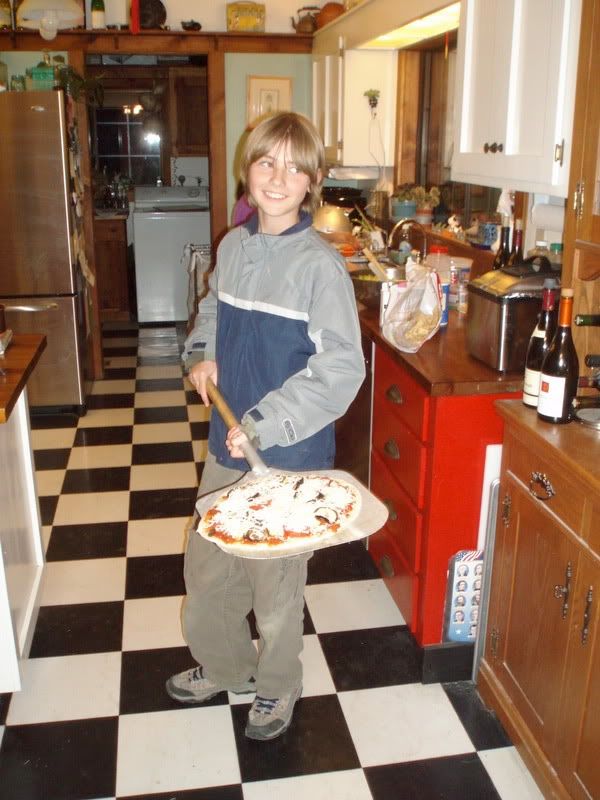
Last night we joined the Pipestone family for dinner. They fired up the cob-oven and Ukiah built an olive and mushroom pie. We talked schools, agriculture, politics and travel and enjoyed their Grenache, especially well paired with the wood-fired pizzas. A welcome party for Brad’s birthday.
We circled the cemetery three times before stopping at a Honda dealership to ask directions. Certain roads were missing from the map and intersections could not be expected as they appeared in the 2005-06 Paso Robles visitor’s guide. For all our efforts, we found ourselves off the beaten track with a winemaker who ignored us until the preferred customers, women wearing foundation and men in loafers, asked about our kids. We joked with the other customers while Mr. Wine worked to project nobility, and poured with some hostility.
Our next stop was a tasting room for hipsters. Aslin skipped "zinbitch" and opted for the complimentary "Biker" tattoo. Stylish baby-doll tees, $15, hung behind the bar. Here the pours were hurried. The "wine pushers" did slow for a bit of gossip on wineries to avoid and told touching stories of three-legged cats. We waved thanks and followed their directions to a small organic winery.
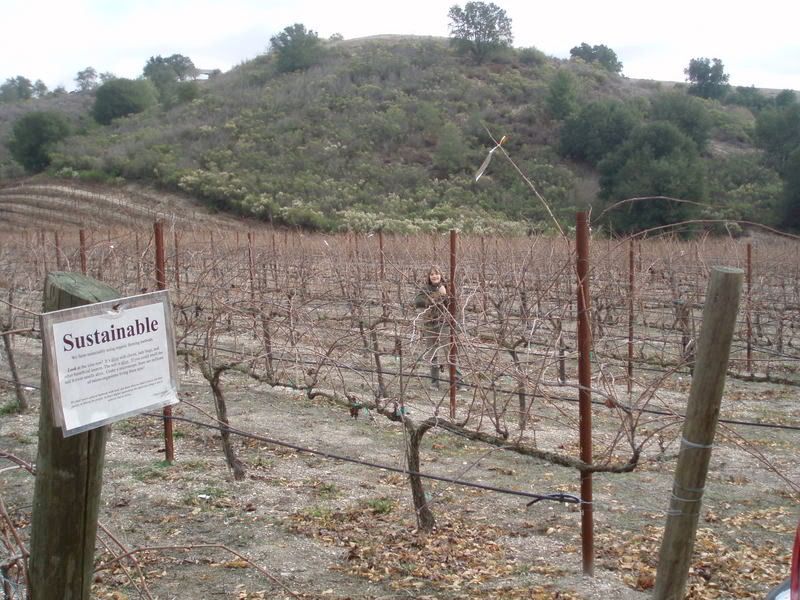
Up the drive, past the horses, past the rings of lavender, we parked across from the goats, facing a small sing posted at the end of the row of vines. “Sustainable.” Other signs gave brief descriptions of grape varieties, soil conditions, and incorporating feng shui and farming practices.
Pipestone Vineyards makes an extraordinary fist impression.
Tasting room introductions led to the easy sharing of stories. Jeff and Florence run a family farm, open to the public. For 10-years, they’ve received the loud talk of LA liberals who support organic farming and leave empty handed and welcomed Orange County conservatives who are unconcerned with the environment, and buy cases of the wine they enjoy. We left with a bottle Rhone Style Red and a little California wine-world enlightenment.
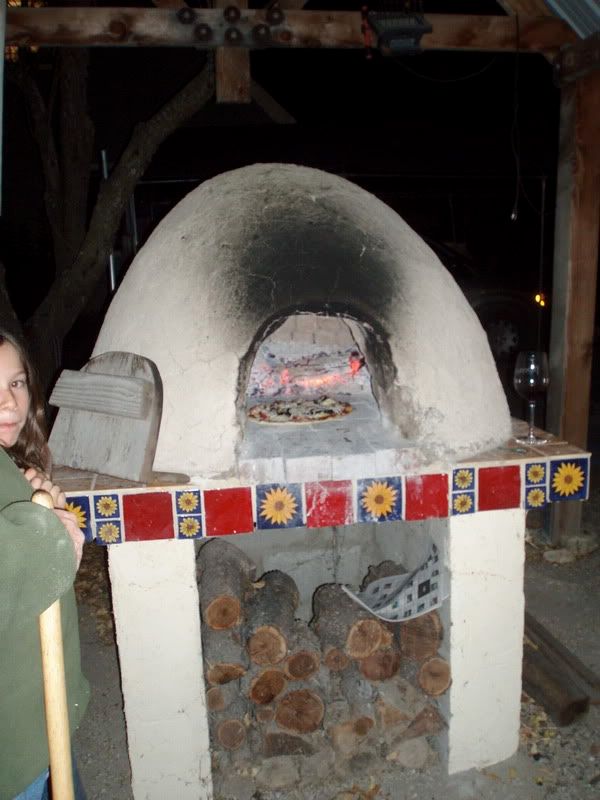
Last night we joined the Pipestone family for dinner. They fired up the cob-oven and Ukiah built an olive and mushroom pie. We talked schools, agriculture, politics and travel and enjoyed their Grenache, especially well paired with the wood-fired pizzas. A welcome party for Brad’s birthday.
Wednesday, December 13, 2006
Confidential
In a closet under the stairs, the remains of this year’s pumpkin harvest are stacked in a lopsided pyramid. I flip the switch, but the light shines only at the top of the stairs, the entrance to the meditation room. In the dark, I choose three. The pile doesn't tumble.

After a half-hour of steaming, and an hour of cooling, the pumpkin is ready to serve its purpose. Pumpkin bread. With a touch of molasses, plenty of clove and cinnamon and an unmeasured mix of baking soda, baking powder and applesauce as an egg replacer, we bake two Big loaves. Enough for desert tonight, breakfast tomorrow.
Here, the communal kitchen means there's always an assortment of quick and tasty stuff for lunch. It also means the bread is gone by the morning. I check both refrigerators, the freezer and a row of lower cupboards, hoping to find some baked breakfast goodness. Nothing. Except that foil covered pie plate in the corner of the counter. Across the top is written…

“This is not for you.
It’s for Krishna.
No peaking. Please.”
Another breakfast of rice and apple.
The contents of the pie plate aren’t the only secret here.
I can't tell you about using the back door to enter a European embassy in the Middle East. Or about crawling under a truck to hide and not openly offend Allah while drinking. I’m not sure if I can tell you about curing cancer with silica, guru "shopping" at age 18, teaching yoga at Folsom prison or working for TV Guide. Brad and I signed confidentiality agreements.

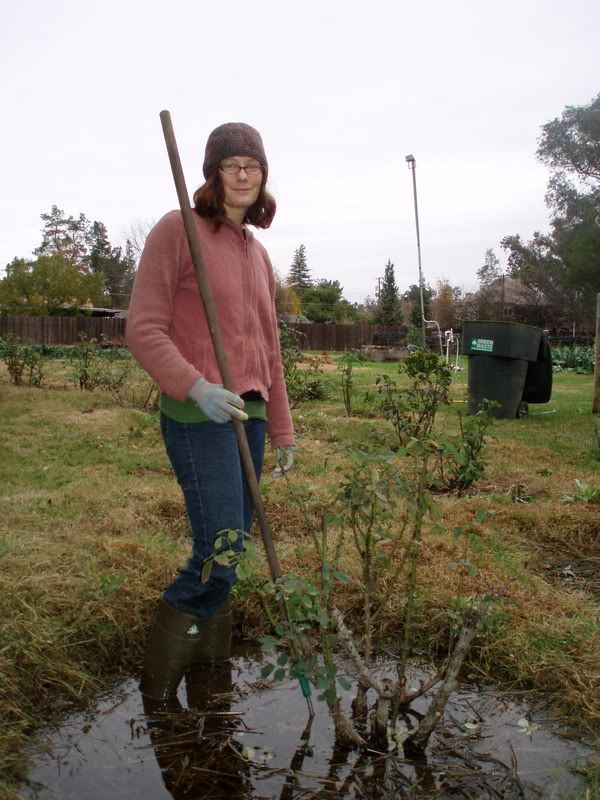
I can tell you that it’s been raining for days, that we’re in a flood plane here, that a flash flood could carry our van away- so we should keep the keys on us, in case we need to move it in a hurry.
The broccoli is harvested, fig tree pruned, compost turned- and now, 35 rose bushes need pruning. In the rain I thought about Alice in Wonderland, counted leaves and sang, “We’re painting the roses red, painting the roses red…Don’t tell the Queen what you have seen…” I’m sure the glowing review I just read for Frank Beddor’s ‘The Looking Glass Wars’ (a new retelling of the classic) prompted my song. I kept humming for hours, stopping occasionally to curse a thorn. “Painting the roses red…” My own little mantra at this Bhakti Yoga center.
After a half-hour of steaming, and an hour of cooling, the pumpkin is ready to serve its purpose. Pumpkin bread. With a touch of molasses, plenty of clove and cinnamon and an unmeasured mix of baking soda, baking powder and applesauce as an egg replacer, we bake two Big loaves. Enough for desert tonight, breakfast tomorrow.
Here, the communal kitchen means there's always an assortment of quick and tasty stuff for lunch. It also means the bread is gone by the morning. I check both refrigerators, the freezer and a row of lower cupboards, hoping to find some baked breakfast goodness. Nothing. Except that foil covered pie plate in the corner of the counter. Across the top is written…

“This is not for you.
It’s for Krishna.
No peaking. Please.”
Another breakfast of rice and apple.
The contents of the pie plate aren’t the only secret here.
I can't tell you about using the back door to enter a European embassy in the Middle East. Or about crawling under a truck to hide and not openly offend Allah while drinking. I’m not sure if I can tell you about curing cancer with silica, guru "shopping" at age 18, teaching yoga at Folsom prison or working for TV Guide. Brad and I signed confidentiality agreements.
I can tell you that it’s been raining for days, that we’re in a flood plane here, that a flash flood could carry our van away- so we should keep the keys on us, in case we need to move it in a hurry.
The broccoli is harvested, fig tree pruned, compost turned- and now, 35 rose bushes need pruning. In the rain I thought about Alice in Wonderland, counted leaves and sang, “We’re painting the roses red, painting the roses red…Don’t tell the Queen what you have seen…” I’m sure the glowing review I just read for Frank Beddor’s ‘The Looking Glass Wars’ (a new retelling of the classic) prompted my song. I kept humming for hours, stopping occasionally to curse a thorn. “Painting the roses red…” My own little mantra at this Bhakti Yoga center.
Wednesday, December 06, 2006
Persimmons
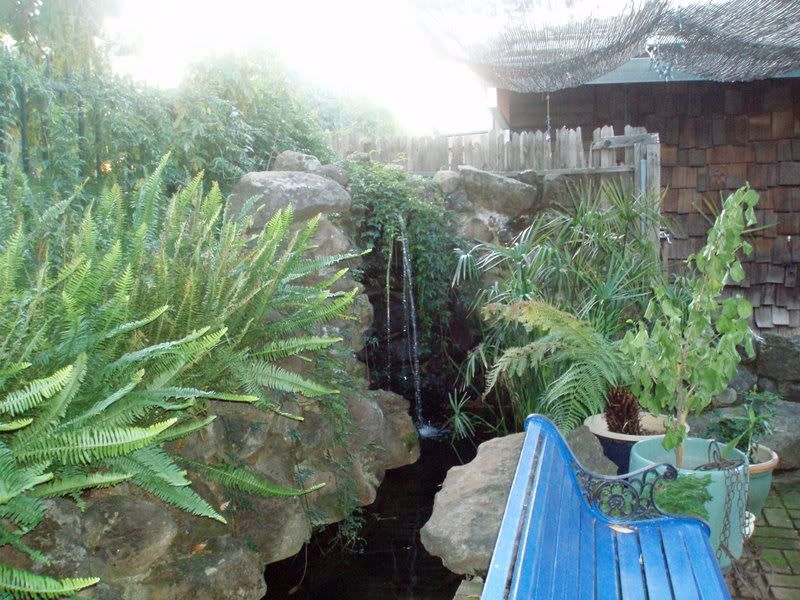
Thanks to slow methodical care of Jack and the crew at Wolfsburg, the van ran strong and trouble-free over Grant’s pass and along Mt. Shasta, delivering us, with confidence, to two acres of a Sacramento suburb. And that’s when I had my moment of concern. Maybe it was only apprehension.
We made brief introductions with some of the staff here at the Meditation Center, toured the gardens and imagined how inviting the pool would be if the weather were warmer. The yoga studio is a converted barn with heavy exposed beams and lush wool carpet. A mural of Krishna and his brother (?) standing in a garden of Eden covers one wall. The air is citrus-spiced but fresh. A tapestry is centered on the south wall.
“Om Hari Om
Hare Krishna Hare Krishna…”
In the kitchen, persimmons crackle in the dehydrator. Vidjapatie offers potato salad, “really more of a vegetable salad with peas and carrot, celery, and the good mayonnaise- not with egg.” The salad has chives and apple, no onion. “Onion has too much passion.”
Andrei, a middle age polish man, melts butter at the stove. He has walnuts soaking in a shallow bowl. “You should always buy nuts at the Russian store. At health food store, like $8 a pound. Russian store, maybe $2.” With carpenter hands, he rolls balls of dough through shredded coconut. His cd skips. The Krisha chants and bells repeat more than usual.
I went to bed last night wondering what to expect in our stay with the Hare Krishnas. I woke this morning to singing, chanting, bells and three bellows of a conch shell. They meditate every morning. If we’re up at 6:00, we’re welcome to join in. For an hour, my dreams rose and fell with their enchanting songs.
We fed the goats, made breakfast and Brad and I spoke silently about how best to navigate this spiritual world. Uddhava brought us the “WWOOF information“ book, a series of notes for volunteers. "It's almost like a transcendental hostel here, " she said as we talked about the day's chores- picking beets, turning compost, walking the injured dog.
“…You’ll find that we like to chant the Hare Krishna maha mantra here, but do know that we are not Hare Krishnas!!” Paragraph 5 of our book raises as many questions as it answers.
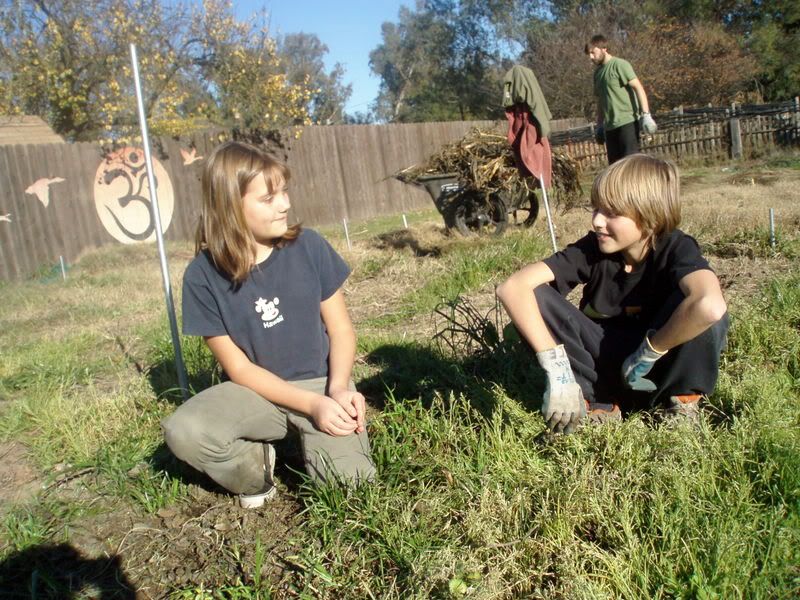
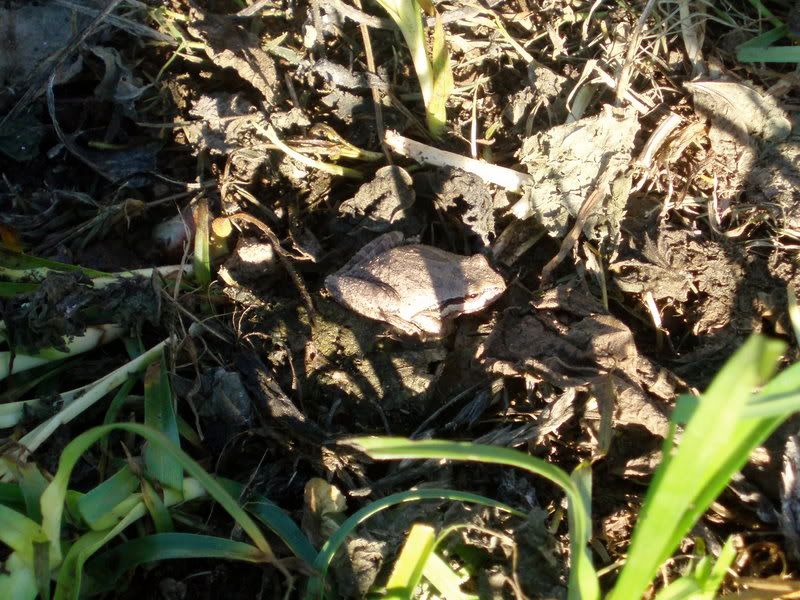
65 degrees is short sleeve weather. We thinned turnip and bok choy seedlings, cleared beds of dead corn and lettuce, thought about climbing the neighbors persimmon tree, and caught a frog Ukiah named Putt-Putt.
Tomorrow we’ll visit lamas at the Rudolph Steiner College farm. I wonder if the kids will bring their GameBoys.
Saturday, October 21, 2006
Good Carrot, Bad Carrot
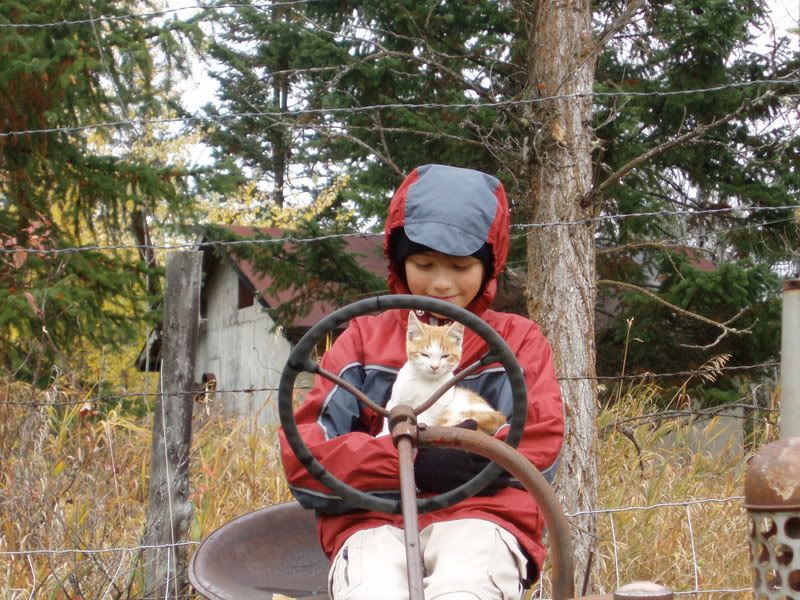
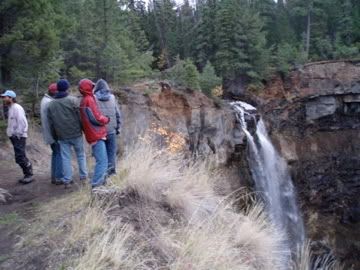

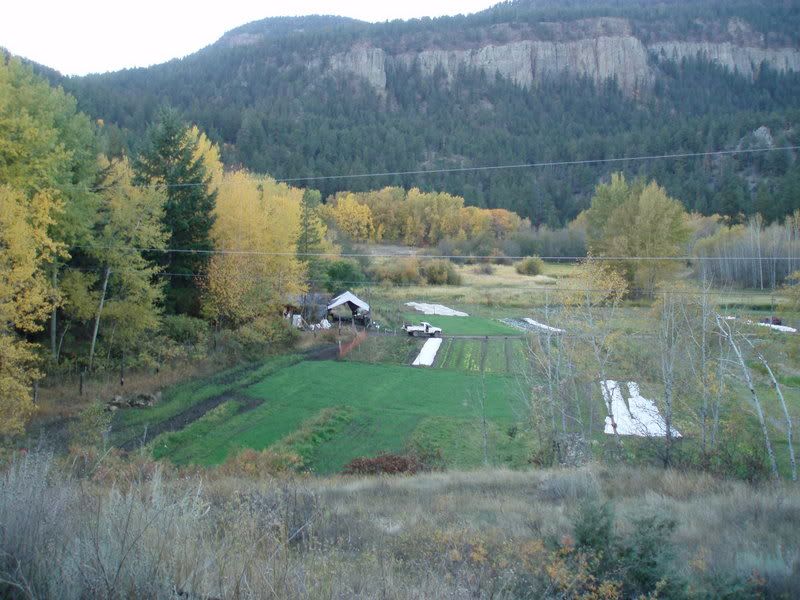
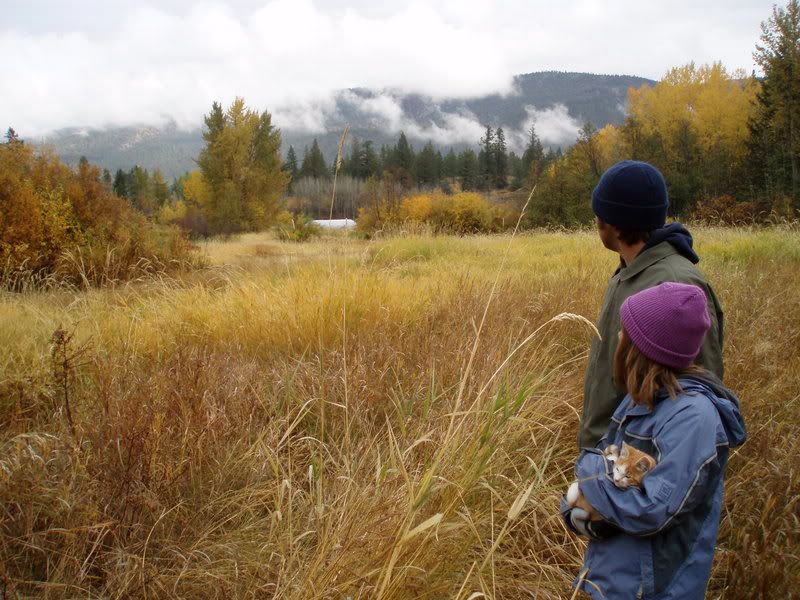
Deadman's Valley, BC
October 7-20
The day can’t really begin with out tea. Green tea and some of Mendel’s freshly milled hot cereal. And sometimes yoga.
We met up with Paula and Mendel at the farmer’s market in Kamloops. Their stand was packed. We couldn’t find an opening to introduce ourselves, so we went for coffee. The market ended at noon, and at a quarter after 12, we pushed through the customers. “Great!” Paula welcomed us, four (unexpected) days ahead of schedule.
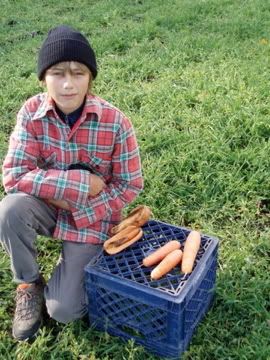
18 kilometers into Deadman’s Valley their driveway twists into the cliffs. Homesteaders drained the lake nearly a century ago, and now, on 6 acres of organic garden they grow 2,000+ pounds of carrots here.
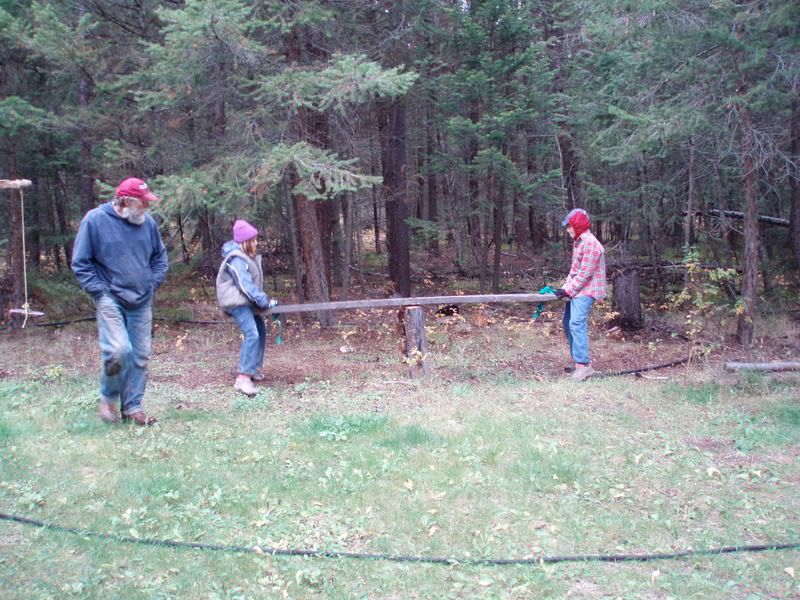
Our first full day at the farm we built a shelter and lay sunflowers across the top. A few dozen friends came to celebrate Sukkot at the farm. After food, wine, blessings, and horseback riding, Mendel called from the house. “Hey, we’re gonna watch Bruce Springsteen...”
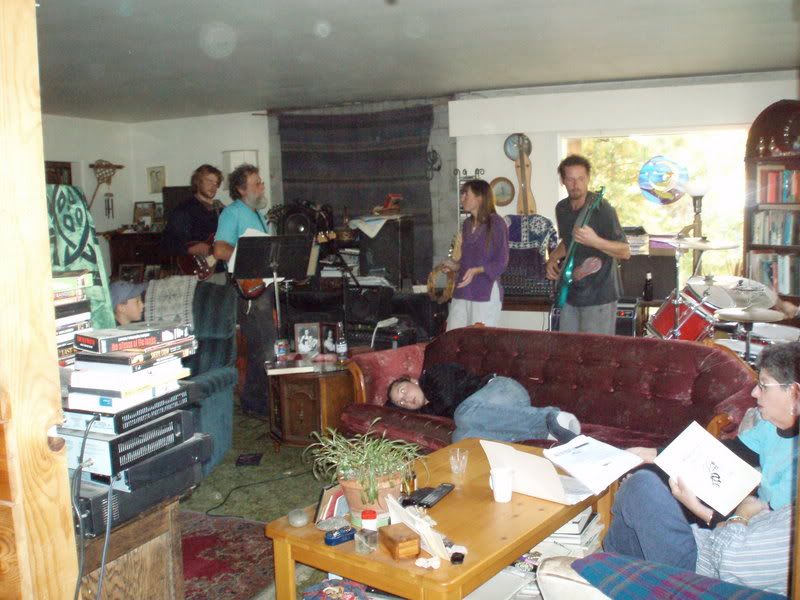
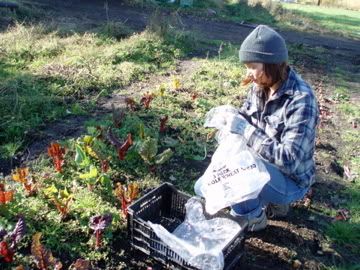
The next morning we picked 500 pounds of carrots, shifting sun umbrellas to give shade as we top and sort in the field, all before Thanksgiving dinner. Every day was a variation on the theme- farming, food, family, friends, music and occasionally, an episode of “Deal or no Deal”.
Mosquito netting isn’t fine enough. The little bastards made their way through. Rust Fly. It’s not easily seen until the carrots are washed. The little brown rings and tiny polka dot holes, Mendel shakes his head, cursing. Next year will be different. Next year the fence will be up too. Then the deer won’t come in and eat the tops of the carrots. They don’t stop at the greens, no. Right into the perfect orange tops- even in the beds without the fly.
“Get him, Mugsy!” The deer are bold. Or hungry. They’ve given up waiting for dark to launch their invasion. From up at the green house we watch them avoid the leeks and head straight for the cabbage. We shout, lending moral support to the dog as she barks and jumps. The deer look up at us, leap over the dog and head back through the fields, to the red hills they share with the bears and pack rats.
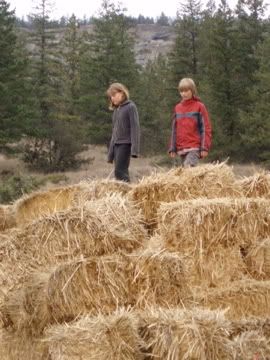
“It ain’t farming if you’re not doing everything twice,” says Saul. And so we sort the carrots. First in the filed- large, small, strong tops, split/rotten. Again after the wash- small, pounders, rust fly, deer eaten, rotten. We bag the beautiful carrots, trim the eaten and separate the split carrots- juice or horse carrot? Ukiah and Aslin finish the 2-pound bags and return to their hay-stack kingdoms.
Mark washes the beets, Brad pulls the last of the celery root and I'm almost through with the chard. Up in the shop, herbs hang drying. We'll have more anise hyssop for tea tomorrow. In the distance, a truck rumbles. "Who's that?" Brad asks. Saul starts up the hill, to tell the hunters they've made a wrong turn. He runs back for his red jacket. Strangers drinking rye in a truck full of guns, looking for one of the lakes. Mendel always directs them back to the highway. Eli holds onto his red-neck streak "for survival." Paula made hummus, chapattis, tzatziki, a greek freast for lunch. Enough for Ukiah to have thirds.
We took a day away from the fields, traveling up the valley, past the home of this year’s Calgary stampede winner. We visited the place it all began- the home and garden the family first built 35 years ago. The bridge across the creek washed out in ’91 but the root cellar still stands. Up here, the terrain changes every mile, and with it a new micro-climate. Lakes, swamps and past the scrub and sage, nested in the evergreens is Deadman Falls. A sheer drop, which the government of British Columbia would like to remind us, is “undeveloped” and should be approached with “CAUTION.” The fog starts to roll in, and we still have firewood to collect.
I don’t quite have the geometry of wood stacking figured out. Saul had to rebuild the pile of fir I loaded. It wouldn’t be farming otherwise.
Subscribe to:
Posts (Atom)